
Seagulls overhead, the faint smell of sulphur on the coast, and waves crashing against the cliffs — the UK’s relationship with its shoreline forms a fundamental part of national culture and identity.
For an island nation with over 10,000 miles of coastline and nearly 40% of its population living within a few miles of the sea, this connection runs deeper than fish-and-chip shops or oceanfront arcades. It is the heartbeat of hundreds of communities.
Yet as the climate crisis intensifies, with violent storms and rising sea levels, the cliffs and sea defences that protect these towns crumble, accelerating the erosion that threatens their future.
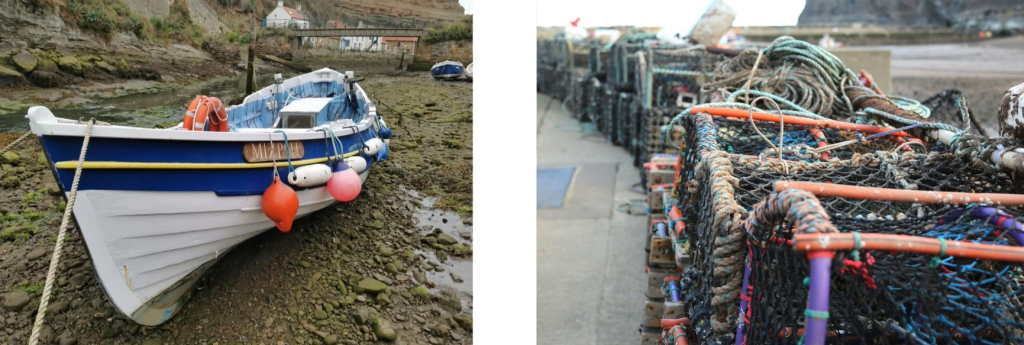
Erosion Explained
Experts say climate change actively causes an increase in the severity of coastal erosion, but how does this actually happen?
According to NASA, atmospheric CO2 levels have reached an unprecedented level — a staggering 50% increase since the pre-industrial era. These values intensify the natural greenhouse gas effect, leading to higher global temperatures. This in turn raises sea levels and fuels more powerful storms, allowing waves to reach further up the coast and strike cliffs more frequently, accelerating erosion.
Ken Buchan is the project delivery manager for Stronger Shores, an innovative project tasked with mitigating coastal change. He highlighted that shoreline erosion “makes coastal communities vulnerable” for a reason which may be overlooked in comparison to traditional physical processes.
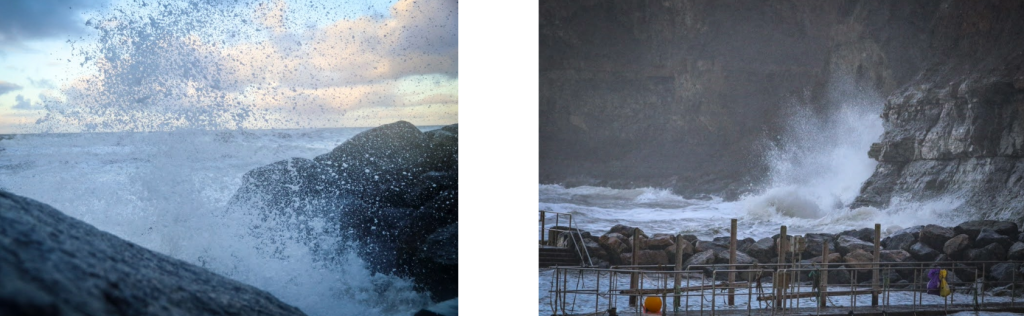
“When sea level rises, there’s coastal squeeze where beaches and so on become smaller,” he said, referring to an issue which Buchan emphasised depreciates the power of beaches as the first line of defence for many seaside towns across the UK.
Building on this, Matthew Agarwala, Ph.D., a professor in sustainable finance at the University of Sussex, discussed how the combination of higher seas, storm surges, and strong winds can allow waves to overcome existing man-made sea defences on the UK’s shores and therefore damage the cliffs supporting these regions.
For these British towns, long fortified by the fishing industry and tourism, these damages are more than physical: They are a burden on both their financial and cultural stability. For instance, OneHome data predicts that by 2100, nearly £600 million worth of assets and over 2,000 properties could be lost in the UK due to coastal battering. Experts like Agarwala say these losses can take different forms, such as damage to roads or water treatment facilities, posing “big risks” to an island nation.
Communities in Danger
As some coastal towns respond to rising sea levels by beginning the process of decommissioning (forcing residents to move out as the town dissolves), it is evident that erosion is not a uniform process, with particular areas more at risk than others. A spokesperson for the Environment Agency stated that certain geological rock types play a role in this vulnerability.
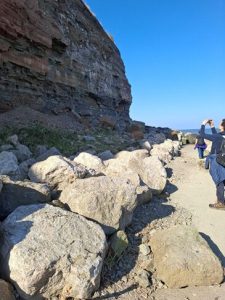
In the southwest of England, cliffs are more prone to hydraulic action, where the sheer force of water wears away the rock, due to a mix of hard and soft stone types dominating the region. By contrast, the east coast, with its glacial deposits, sandstone, and clay boulders, experiences a faster erosion climate characterised by rock and sand grinding along the coastline. This is demonstrated by East Yorkshire’s Holderness Coast, one of Europe’s fastest-eroding coastlines.
Agarwala expanded on this, discussing an interesting correlation he found amongst these vulnerable groups.
“Some of the communities that are most at risk from climate change are also the communities that are voting for Conservatives or are shifting to Reform [UK],” he said in reference to the political parties which are less supportive of environmentalism in their policy-making.
“There are places that are viable today and that have been viable for centuries in the past, that will not be viable even 20 years into the future,” Agarwala said.
Zooming in
On the North Sea’s boundary lies the small village of Staithes, where maritime industry and seaside tourism form the engine of local life.
“For a long, long time, fishing was the main job for the people in the village, along with some mining. These days it’s tourism,” said Sallie Hernandez, a local resident who has lived in the area for 16 years. “A lot of people refer to Staithes as their happy place and visit more than once, twice a year.”
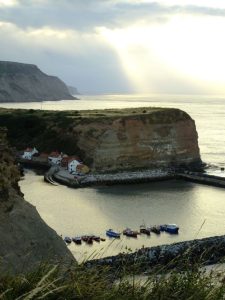
Despite the area’s economic success and picturesque nature, coastal deterioration has battered the region for decades, with the community pub, The Cod and Lobster, washing away on multiple occasions. Most notably, on the northwest of the village resides a small hamlet known as Cowbar Cottages, accessible by a singular entry route named Cowbar Lane.
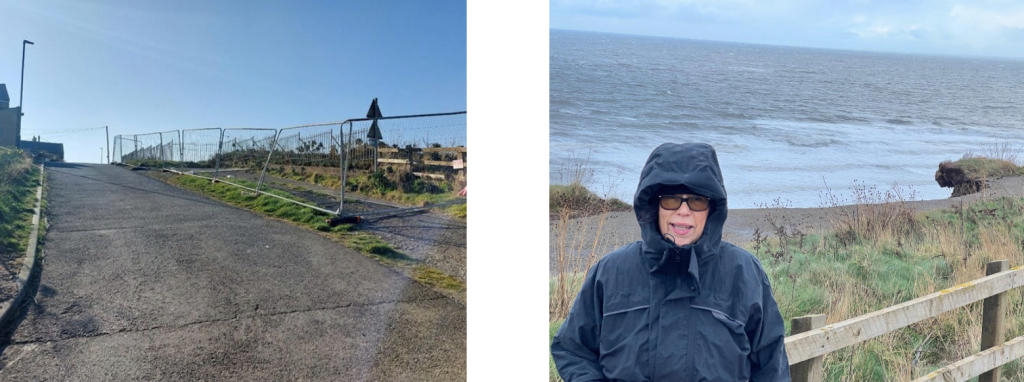
Over many years, this access road has eroded and been rebuilt multiple times under the burden of perpetual wave action from the sea below. Resident and local authority concerns are now escalating, following a rockfall event in October 2024 that has placed the route at immediate risk of collapse.
“Walking through today, big chunks are missing,” Hernandez said, on one of her daily walks through Cowbar. “All along by Cowbar Cottages is all fenced off. I recently saw some drone footage of the cliff and it was terrifying to see what was going on underneath.”
A council report published by North Yorkshire Council and Redcar and Cleveland Borough Council has since attributed reasons for the rockfall. Most strikingly, it acknowledges erosion processes exacerbated by sea level rise, increased storm frequency due to climate change, and foreshore lowering — a process where wave energy removes protective layers of sediment at the base of a cliff — as integral factors.
Council efforts are advancing to manage the issue and involve a three-phased road realignment, whereby the lane is gradually moved away from the cliff edge over 50 years.
“Keeping access is vital. There are cottages down there that are only accessible via that road and the lifeboat station, so all these things would need to move if access cannot be maintained,” Hernandez said.
Elsewhere in the village, the council has installed sea defences in the form of rock armour and breakwater piers to protect the harbour from the North Sea. Despite this, local anxiety prevails, particularly following the loss of a child’s’s life at Seaton Garth, Staithes, due to a rockfall in the summer of 2018.
Stemming the tide
For regions like Staithes, mitigation frameworks named shoreline management plans are the leading unit tasked with stemming the tide of coastal erosion. Using factors such as population, technical feasibility, and climate change, these models assign a planned course of action to every section of the English coast.
But, these schemes often focus on hard-engineered solutions, such as sea walls, which sustainability experts like Agarwala argue come with significant drawbacks.
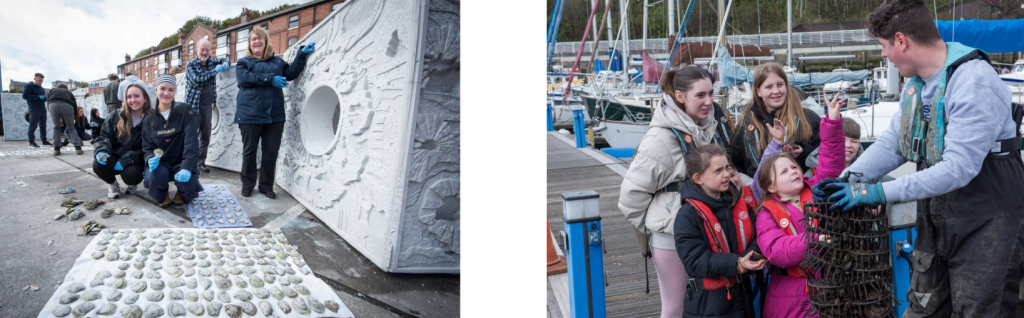
Enter Stronger Shores, part of the UK Government funded £200 million Flood and Coastal Resilience Innovation Programme. This research project focuses on innovative ways of improving coastal resilience and is one of 25 projects across England considering new ways of managing coast erosion and flood risk. Having started in 2023, Stronger Shores is supporting research and habitat restoration efforts across the North East coast of England – and is rooted in a philosophy of trial and error.
“At this stage it’s quite experimental, it’s quite research orientated,” said Ken Buchan, the delivery manager of the project. “If things don’t work, that’s okay. Because we are learning from that.”
The focal point of Stronger Shores targets soft-engineered solutions to climate change, exploring how oyster restorations, kelp forests, or seagrass meadows can improve the robustness of maritime communities.
Buchan discussed how one PhD student at Newcastle University is actively using artificial kelp structures in laboratory wave tanks to how kelp can reduce wave energy.
“With the [kelp] fronds being up on the surface of the water as the wave energy comes through, that energy gets dissipated by the top of the plant. It’s like it puts the brakes on as the waves come over,” Buchan said, referencing how kelp systems can mitigate erosive forces.
With the project set to finalise in 2027, one main ambition drives Buchan and his team: the creation of a toolkit combining all the research, methods, benefits, and challenges from Stronger Shores. It is hoped this will guide coastal engineers nationwide, helping to protect the UK’s enduring bond with its marine identity.
Given the uncertain future, Buchan is left asking: “Can we [as a nation] be doing things differently from what we’ve currently been doing to try and improve resilience and protect coastal communities?”
This article was originally published on Planet Forward, and has reached the final stage of their 2026 Storyfest awards. Winners will be announced on Friday, April 17 at the Planet Forward Summit in Washington, D.C.
If you enjoyed this piece, it can be voted for their Fan Favourite Award here.

I’m Jey, a journalism student at Teesside University and the current head of news for the TUXtra website. Following a background in economics and geography, I hope to cover a wide-range of topical issues!