
The term ‘ghost fishing gear’ refers to lost or discarded fishing equipment, such as trawl nets and angler lines, found in our oceans and washed up on our beaches. And, like many coastal regions, is a pressing issue for the North East, posing huge risks for wildlife, microplastic pollution and local fishermen.
Untethered lobster pots, loose nets and snapped sections of rope for instance, are all known to ensnare seals, whales and fish, causing suffocation or starvation.
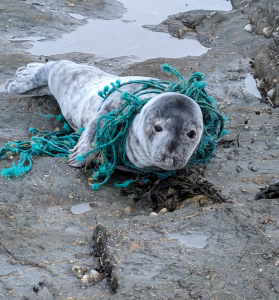
For many, it is easy to pin blame on local fishers. But, what really drives this issue, and how is it being tackled?
Global to Local
A report by the World Wide Fund for Nature estimates that ghost gear is responsible for nearly one million tonnes of fishing equipment entering the oceans each year, affecting approximately 66% of all marine mammals. In doing so, this introduces toxic chemicals into the human food chain through consumption of fish, while also devastating marine ecosystems central to climate regulation and ocean health.
The main bulk of the issue can be attributed to gear lost by large industrialised trawlers yet can also accumulate when buoys and lures go missing from aquaculture farms and recreational angling groups.
Certain remote areas of the globe can experience intentional discard of equipment alongside illegal, unreported and unregulated (IUU) fishing whereby vessels cut gear loose to evade detection by authorities. But, for the North Sea, this is a relic of past, says Whitby fisherman Barry Goodhall.
He said: “Trawlers dumping gear over the side used to happen more in the 80s.”
The 44-year old said nowadays gear is mostly lost when it is dragged along the seabed or due to harsh weather conditions displacing pots on the side of boats.
“Lead weights and rigs are usually lost due to snagging on the rough bottom [of the seabed]. Lobster fishermen often lose pots in bad weather but due to their expense they usually shot a grapple over and drag until they retrieve them. Although, some are never found.”
Adverse weather conditions and historic naval battles have contributed to the buildup of nearly 530 shipwrecks off the coast of Whitby. Alongside overfishing, this has created what 49-year old angler Daniel Middlemas describes as a self-reinforcing cycle of ghost gear.
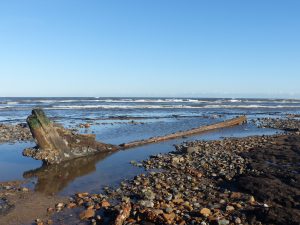
Decades of fishing in seaside towns like Whitby have driven declining fish populations to seek refuge within abandoned structures, where they are less exposed to commercial vessels. However, this change has drawn fishers to the same locations in the hunt for profit.
Middlemas explained that when nets and lines are deployed below the surface, they often tear on the wrecks’ sharp features, contributing to the accumulation of ghost gear and placing further pressure on already depleted fish stocks, perpetuating the cycle.
Clean-up efforts
In his spare time, father-of-one and chemical worker Stephen Smith spends his hours diving and retrieving Teesside’s ghost gear. His charity, Clean Planet UK, was officially established in 2022 and can collect up to 200,000 metres of discarded equipment each year – enough, if laid in a straight line, to stretch between Middlesbrough to Edinburgh.
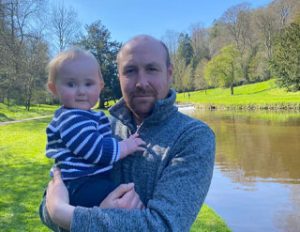
However, Smith’s beach and sea clean-up career started far beyond Teesside and begun with a diving course in the mediterranean town of St. Julian’s Bay in Malta.
He said: “When I first started diving around about 10 years ago and I’d done my course in Malta, I saw the state of St. Julian’s Bay. It was coated in litter to a point where you could hardly see the ground. There was no coral, no fish, anything.
“And, when I started diving in UK waters, I realised we had the same kind of sea. So, I started cleaning at our local Gare in Redcar – South Gare.”
Upon retrieval, collected ghost gear is either returned to local fishermen who have reported losses or sent to recycling centres for waste-to-energy – an alternative which Smith claims is more environmentally friendly than landfill.
The organisation is recognised for its use of underwater robotic technology, capable of surveying the seabed for litter piles, while also processing equipment collected by other local conservation groups. Most notably, Smith has worked with Redcar-based volunteers, South Gare Litter Pickers, who collect and cut washed-up fishing debris.
Co-founder of the South Gare Litter Pickers, 59-year old Matt Stilwell, said: “It’s surprising how much comes up on the beach. When it comes in, it’s all tangled up – completely knotted together.”

Next steps
Despite sustainability efforts, Smith and his team are encountering “major issues” associated with being a marine-based organisation.
“The government are quite black and white in the ruling of the sea,” he said. “You are either pleasure or commercial. There’s no in-between. There is nothing for charities. And because we are theoretically doing work out at sea, we’re being deemed as commercial, which has come as a massive implication for cost and things that we need to get put in place.”

He explained that all members of Clean Planet UK are unpaid volunteers and it would cost close to £1,000 per member to acquire the licences needed to function as a commercial business. They are now striving to gain British Sub-Aqua Club status, a position that would classify the charity as “pleasure” and cover the price of domestic diving.
Still, Smith argues that one thing remains paramount to cleaning our oceans: more awareness.
“The key part of ghost gear is awareness,” he said “People don’t realise even a lobster pot that’s been washed up on the beach could have been in the sea for 10 years. It’s split. It’s sharp and it could have carried bacteria.
“Ghost gear continues fishing long after it’s been lost. It attracts bottom eaters like lobsters and crabs and then they become bait, attracting fish and seals. It just goes on and on.”

I’m Jey, a journalism student at Teesside University and the current head of news for the TUXtra website. Following a background in economics and geography, I hope to cover a wide-range of topical issues!