
To celebrate International Mermaid Day on March 29th – an annual tribute to merfolk lore, art and storytelling – TUXtra’s Jey Draper explores Skinningrove’s infamous merman tale and how it roots itself into local tradition today.
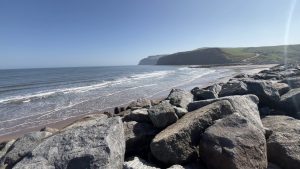
Next to the ironstone cliffs of East Cleveland, on the coast of the North sea, lies the quant village of Skinningrove – a community shaped by the meanders of its beck and steep, wooded valley.
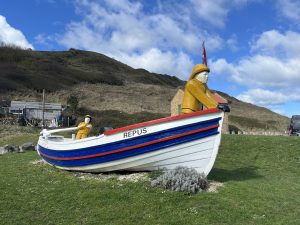
Known for its rugged charm, Skinningrove is rooted in a history of mining, Norse leather-tanning, and fishing economy, but is also the origin for one of northern England’s oldest folklore tales.
Yet one question remains: How do the people of this blue-collar community see the legend of the Skinningrove Merman?
The Merman
The tale of Skinningrove’s mythical seaman – half human, half fish – dates back to the early 16th century when England was ruled by the Tudors. However, as the story has passed through local gossip and decades of uncertainty, the events of this have blurred.
The mention of a merman on Skinningrove’s shingled beach can be found in an wide-range of old, English novels, yet can first be sourced in the Cotton Manuscripts. This collection of handwritten documents, once preserved by Sir Robert Cotton (1571-1631), outlines everything from Anglo-Saxon history to Greater Cleveland hearsay.
Locals say the story began in 1535, when townsman fishers ventured out to sea on the daily swell, braving the hardy conditions. On their endeavours, they are said to have hauled the most unexpected catch: a creature so withered it could not fend for itself. It is believed the merman only accepted raw fish as food, and opted to communicate through loud, sharp “skreakes” rather than human speech.
But, this is where the story becomes contested. Whilst most residents remain sceptical, opinions still differ on how the tale should be told.
Luke Smith, 31, like many locals, has heard the story of a merman leaving the village of his own accord, despite efforts to accommodate him. It is told the creature left his cellar in the old Timms Coffee House – now known as the Moonfleet Boutique Hotel – once his strength had returned.
He added: “It’s said he was kidnapped and kept in a cupboard under the stairs until he escaped and returned to the sea.”
Other residents, such as Tanya Spedding, 38, encountered a more humorous side of the fable, with reports of the merman showing a playful flirtation toward old townswomen. This version of events dates back to Rv. John Graves’ book ‘The History of Cleveland (1808)‘ where the Skinningrove seaman was described as if his “phlegmaticke breath had been touched with a sparkle of love”.
She said: “I remember stories from when I was a child that he was caught and kept in a house – and that he liked women.”
It is understood that this lead to the merman’s eventual departure from the village, as local townsfolk grew jealous of his captivation and sought of a mermaid to win back his charm.
A lasting tale?
Wade Zane is a Skinningrove resident and short-film maker whose work has been shown at the Land of Iron museum and does not believe in the story of a merman becoming a member of the coastal community – a view shared by the most of the village. However, Zane does recognise the role folklore plays in British heritage.
He said: “The idea of mermaids and mermen have no particular, or near no prolonged study or evidence. Though I am interested in folklore, the field provides less evidence than the supernatural and paranormal does.
“Local folklore is important to be preserved. Whether true or not, folklore is a part of our heritage, based on stories shared through generations.”
Many in the village believe the merman fairytale roots itself in some form of truth. It is conspired that a Scandinavian man visited the area on his travels across the North Sea, and was captured and eventually mistaken for the infamous creature we now know.
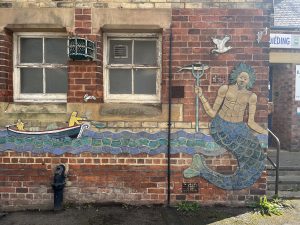
Regardless of its truth and ambiguity, the Skinningrove Merman remains central to the village’s culture and identity in the current age – a reminder of the sea’s hold on its people and stories. A tiled mosaic on the side of the Riverside Building reflects just this, illustrating how fisherman throw their first catch of the day back to the sea in commemoration of the lasting tale.

I’m Jey, a journalism student at Teesside University and the current head of news for the TUXtra website. Following a background in economics and geography, I hope to cover a wide-range of topical issues!